Sarnia Emergency Tree Removal Help
You require Parkhill arborists who understand Sarnia's lake-effect winds, clay soils, and utility setbacks. We adhere to ISA A300/ANSI Z133, ICS-style traffic control, and employ precision testing equipment (resistograph, moisture, thermal) to assess, prune, or safely remove with certified equipment and safety gear. Rely on quantified prescriptions, protected work areas, and machinery setup that ensures the safety of structures and pedestrians. Ready for emergency response 24/7 with digitally tracked professionals, we document visual documentation, risk evaluations, and treatment programs. Keep going to see our methods for protecting your property.
Main Insights
- Sarnia tree care experts dealing with challenging weather and soil conditions, while considering drainage requirements and utility clearances for professional and regulated tree maintenance.
- ISA-compliant assessments employing resistograph examination, soil testing, and risk assessment matrices to identify and diagnose concerns and formulate targeted treatment strategies.
- Specialized pruning and canopy care that maintains structural integrity, keeps live foliage removal to 20-25%, and improves structural stability.
- 24/7 emergency response with GPS-monitored crews, featuring professional tools, secure tree elimination, professional stump processing, and comprehensive location rehabilitation.
- Our operations are fully insured and comply with ANSI/CSA compliance requirements, utilizing safety-certified tools, well-documented safety programs, and detailed documentation for property owners and insurers.
The Importance of Local Arborists for Sarnia Properties
As trees adapt to site-specific conditions and microclimates, local arborists bring the local expertise Sarnia residences demand for reliable, research-backed service. You get professionals who know about lake‑effect winds, clay‑rich soils, drainage limitations, and service line restrictions common to your streets. They coordinate pruning windows, securing techniques, and debris management to prevent damage to structures, pedestrians, and services.
Regional knowledge strengthens compliance. Qualified tree experts align their recommendations with city ordinances, power line safety standards, and environmental protection schedules. Through community engagement, they share risk assessment guidelines and coordinate neighborhood-wide safety measures after storms. Their weather-based knowledge help you anticipate ice-load failures, insect-related damages, and drought stress, so you can plan interventions before problems escalate. You obtain targeted, well-supported recommendations that protect tree health and property protection.
Complete Tree Health Evaluations and Services
Our first step involves a detailed tree health evaluation that integrates diagnostic evaluation, site analysis, and visual assessment. We record species, age class, exposure, and soil profile, then carry out root collar inspections to identify decay, girdling roots, and ground level alterations. Utilizing moisture measurements, resistograph data, and chlorophyll fluorescence testing, we quantify structural and physiological stress.
We provide periodic evaluations customized for Sarnia's climate: spring growth and tissue evaluations, summer foliage nutrient assessment, fall root health monitoring, and winter bark and disease surveys. We test soil for pH balance, electrical conductivity, soil compaction, and disease organisms, and map problem areas aligned with ISA best management practices. Care plans specify proper ground ventilation, organic cover levels, water management, PHC applications, and trunk protection strategies to reduce hazard potential and extend lifespan.
Professional Tree Pruning and Crown Management
Optimize tree stability and security with pruning techniques that focus on biological principles and load distribution, rather than mere aesthetics. You'll minimize potential hazards by making precise cuts at the branch connection, preserving compartmentalization and vascular flow. Start by conducting a thorough canopy assessment: identify twin trunks, stretched laterals, and uneven weight distribution. Implement weight balancing strategies to balance forces, reducing rotational pressure during wind events. Use targeted thinning-not over-thinning-to maintain inner foliage, improve ventilation, and lower drag forces without triggering excessive growth.
Set clear pruning guidelines: cut back no more than twenty to twenty-five percent of live foliage per season, keep at least 33% branch diameter at unions, and maintain clearance requirements around buildings and power lines. Focus on deadwood, crossing limbs, and infected tissue. Record growth response and conduct inspections on a three to five year cycle to preserve structural integrity, light distribution, and storm hardiness.
Safe and Efficient Tree Elimination Solutions
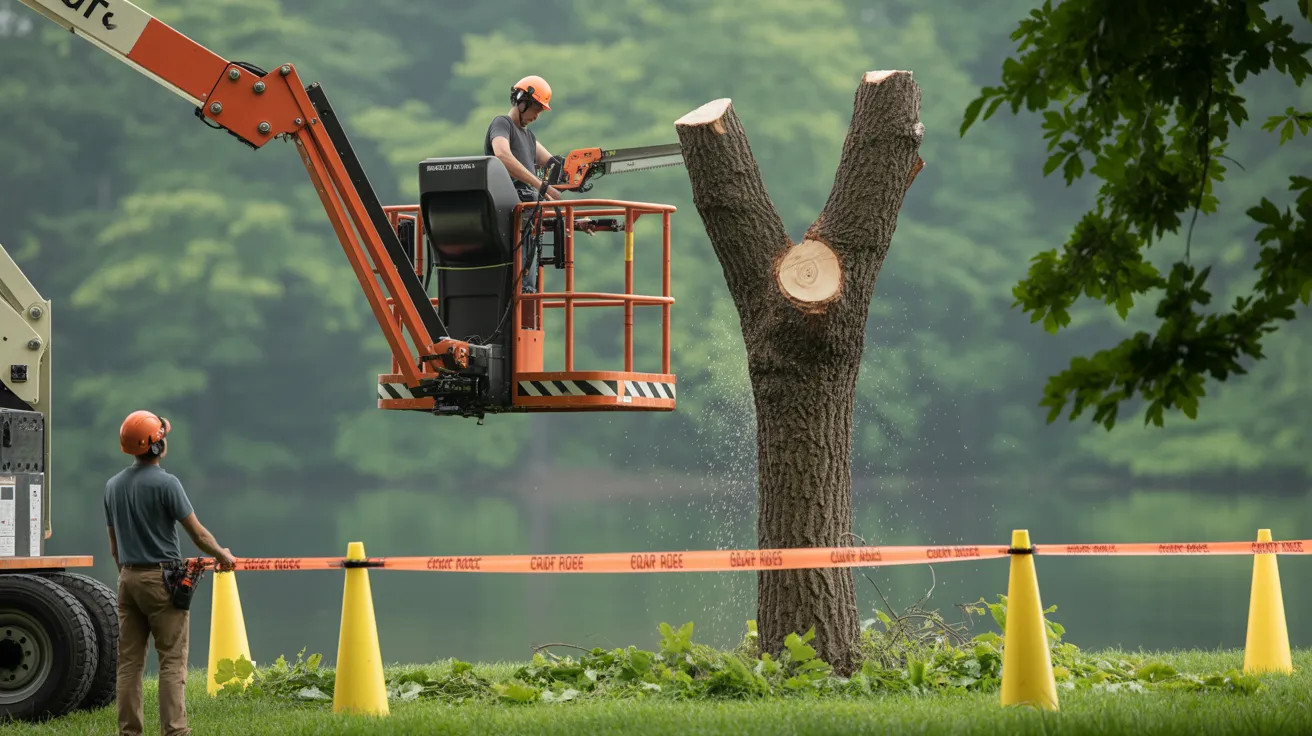
If pruning isn't sufficient to address structural defects, disease, or clearance concerns, tree removal becomes necessary. We implement a comprehensive strategy, including location assessment, rigging plans, and controlled cutting techniques to ensure property protection. Qualified team members safely deconstruct trees check here in controlled segments, using industry-standard gear, mechanical brake systems, and tag lines to direct removal operations. Utility verification is performed, create exclusion perimeters, and comply with ANSI Z133 and ISA BMPs to ensure maximum safety.
The removal of stumps and roots completes the operation, stopping sucker growth and conflicts with underground infrastructure. We use stump grinders sized to access narrow areas, and we backfill with appropriate material to preserve the level. Debris is recycled when feasible, and we ensure the area is tidy and suitable for new plantings.
Emergency Storm Response and Risk Management
During severe weather events Sarnia, you need immediate storm management that dispatches professional personnel, insulated equipment, and traffic control within hours to secure storm scenes. Our services include safety evaluation procedures that comply with ISA and ANSI A300 standards: comprehensive tree evaluations, weight distribution studies, and utility line assessments. With these systematic approaches, you can decrease remaining dangers, identify urgent tree work, and reestablish safe passage.
Emergency Storm Deployment
Following extreme weather conditions, Parkhill Tree Service springs into action to stabilize affected areas, clear dangerous debris, and clear pathways across Sarnia. Customers benefit from swift support coordinated through a 24/7 dispatch, GPS-tracked fleet, and strategically placed equipment. Professional staff deploy with specialized tools including insulated saws, rigging gear, traffic control kits, and chipper/loader units to clear vital routes and secure utilities.
You benefit from coordinated community response with public works, utilities, and emergency services to handle compromised trees, blocked roads, and downed power lines impacting buildings. Crews implement Incident Command System protocols, create safe work zones, and adhere to ANSI Z133 and provincial standards. They execute controlled dismantles, crane picks for substantial tree falls, and material sorting for streamlined hauling. Records comprise time-stamped photographs, debris tracking documentation, and detailed reports to facilitate insurance claims and municipal reporting.
Hazard Evaluation Standards
Even though workers respond swiftly, they won't proceed until a comprehensive hazard assessment establishes the area is secure and objectives are clear. You'll see a methodical process: create exclusion zones, check utility status, and secure traffic patterns. Teams conduct risk mapping to detect tensioned limbs, compromised stems, root-plate failures, and secondary strike hazards.
They employ specialized rangefinders, clinometers, and thermal imagers to identify potential hazards and structural weaknesses. Load paths are analyzed to predict potential breakdown points. Risk categorization systematically identifies sections by hazard category, matching extraction methods to risk levels: manual rigging, mechanical winching, or controlled felling. You'll be given detailed documentation, including photos, hazard assessments, and safety recommendations. This protocol minimizes injury risk, avoids cascade failures, and returns access with documented safety parameters.
Stump Grinding and Site Restoration
Restoring your landscape begins with meticulous stump grinding that removes trip hazards, stops regrowth, and readies the site for future development. We calibrate grinder depth to 6-12 inches below grade, corresponding to tree species characteristics and site loads. You get controlled debris management, guarded work zones, and verified utility locates prior to removal.
Once grinding concludes, we execute strategic root removal to prevent lateral sucker formation and resolve surface heave risks. We separate chips from mineral soil to avoid nitrogen drawdown, then fill with a sorted aggregate-soil blend that promotes compaction and soil stabilization. The final grade ensures positive drainage and uniform subgrade tolerances. If you plan hardscapes or replanting, we furnish detailed soil analysis and structural capacity guidance so the rehabilitated footprint performs safely and predictably over time.
Strategies for Disease, Pest, and Soil Management
Because tree health relies on prompt identification and controlled treatments, we combine diagnostics, thresholds, and corrective measures into a comprehensive management plan. We initiate with detailed examinations, employing pathogen testing, insect trapping, and crown assessment to verify pathogens and pest populations. You get clear intervention thresholds that determine when to act, eliminating excessive interventions.
We begin by addressing soil problems. We analyze key soil parameters including pH, EC, CEC, and organic content, then implement precise amendments and verified soil inoculants to improve root symbiosis and nutrient availability. For addressing pest and disease issues, we use precise pruning, sanitation, and approved chemistries under integrated pest management protocols. We coordinate applications based on life cycles, safeguard beneficial organisms, and document results. You get detailed monitoring reports, periodic review schedules, and modifications based on observable plant reactions and site conditions.
Insurance Coverage, Equipment, and Safety Standards
Confirm the crew utilizes professional-grade climbing gear including climbing ropes, friction devices, calibrated chainsaws, and verified rigging gear. Ask for written safety protocols conforming to ANSI Z133 and CSA/OHS standards, addressing safety equipment, rescue readiness and thorough job hazard evaluations. Verify complete liability and WSIB/worker's compensation coverage, and request certificates naming you as an additional insured before work starts.
High-End Arborist Supplies
Trust Parkhill Tree Service to utilize top-tier arborist equipment calibrated for precision and safety. You get access to high reach aerial lifts with safety-rated booms, surface-friendly outriggers, and weight detection to prevent overcapacity events. Teams employ GPS guided fleet tracking to position equipment strategically and minimize idle time on-site. Chain saws include inertia-activated chain brakes and low-kickback bars, while rigging hardware features traceable ratings that match calculated forces. Chippers are maintained to OEM specs; chipper performance is validated through cutting system inspection, anvil alignment, and mechanical performance checks. Stump grinders run guarding and emergency stops verified per CSA standards. Parkhill maintains active liability and WSIB coverage, and records pre-job inspections, maintenance intervals, and calibration reports to document compliance and safeguard your property.
Advanced Safety Standards
Consistently, Parkhill Tree Service executes a documented safety program that combines safety measures, validated tools, and verified insurance coverage. You receive from a well-established safety culture that implements workplace risk assessments, team safety meetings, and duty designations. Crews employ protective equipment aligned with job-related hazards, follow lockout tagout for energized tools and chippers, and install worksite signage to manage public and traffic interfaces. Supervisors maintain safety incident records and safety event logging to enable corrective actions and measurable trend reduction. You'll see properly adjusted equipment, safety-approved lifting gear, and equipment verification checks documented before mobilization. Field teams adhere to industry regulations, with continuous training on fall protection, aerial rescue, and power line safety. Documentation is audit-ready, chronologically tracked, and validated at each phase.
Full Liability Coverage
While each job comes with its own unique risk profile, Parkhill Tree Service backs each job with comprehensive liability insurance that aligns perfectly with their systematic safety measures and certified equipment. You receive protection that covers actual field hazards-encompassing rigging loads, aerial lift operations, chipper exposure, and traffic control interfaces. We establish precise policy limits for property damage, bodily injury, and completed operations, corresponding to safety evaluations completed before project mobilization.
Our insurance complements CSA-compliant PPE, yearly equipment evaluations, and operator certifications, addressing areas that self-insurance fails to protect. We provide certificates of insurance when needed, specifying endorsements, additional insured status, and waiver of subrogation when required. In the event of an occurrence, our simplified claims process documents accountability sequence, timestamps, and event factors, speeding up resolution while preserving your project timeline and cost certainty.
Upfront Pricing, Booking, and Maintenance Programs
Because clear information reduces risk and surprises, Parkhill Tree Service provides detailed, itemized estimates that specify scope, methods, equipment, disposal, traffic control, and permit requirements before any work begins. You get detailed price information based on specific parameters-DBH, canopy spread, access constraints, and utility proximity-so you can assess choices and comprehend pricing factors. We detail ANSI A300 practices, PPE, and exclusion zones in your service agreement.
You'll get a specific appointment time, pre-job notifications, and alternative solutions for weather-related issues or utility interruptions. Technicians show up with calibrated gear and Job Safety Analyses completed. After completion, we deliver a post-service report with images and professional advice. To sustain tree health and lower the risk of issues, we provide regular care programs with scheduled assessments, periodic pruning, insect surveillance, soil care, and cost planning.
Common Questions and Answers
Do You Offer Eco-Friendly Disposal or Wood Recycling Options for Removed Trees?
Yes, you can green disposal and timber recycling services. We carefully divide timber, limbs, and wood chips for repurposing: creating lumber, generating mulch, or providing biomass material. When possible, we strategically place logs or woody debris for wildlife habitat, complying with city guidelines and invasive plant protocols. We clean our machinery to prevent pathogen spread and furnish comprehensive documentation. You'll receive detailed disposal strategies, weight records, and safety protocols following professional guidelines and safety standards.
Can I Keep the Wood Chips or Logs for Personal Use?
Definitely, you can preserve wood chips and logs. This makes a huge difference in the long run. Utilize chips for garden mulching; they regulate soil temperature, prevent weeds, and maintain moisture. Allow chips to decompose 3-6 months to reduce nitrogen drawdown. For logs, implement safe firewood storage: split for quicker drying, raise above ground, protect the upper portion, verify 15-20% moisture (use a meter), and store wood 6-10 feet from structures to decrease pest and fire risk.
Can You Tell Me About Your Seasonal Discounts and Referral Programs?
Absolutely. You'll usually find seasonal special offers during off-peak seasons (late winter or mid-summer) for pruning, removals, and stump grinding. Ask for written conditions, eligible services, and blackout dates to ensure safety-critical tasks receive appropriate attention. Many providers also offer referral bonuses-typically a specific discount or credit-after the new customer finalizes and settles their service. Check limits per household, combination with other discounts, and expiration dates. Make sure quotes and savings are recorded on your invoice.
Can You Assist With Municipal Permits and Bylaw Compliance Documents?
We provide full bylaw and permit support from the start until completion. We take care of assessing applicable municipal bylaws, preparing documentation, arranging arborist reports, and processing required applications. We organize professional assessments, utility locates, and traffic safety protocols as required. You'll receive comprehensive risk assessments, site maps, and tree work justifications following ISA and ANSI A300 standards. We track authorization progress, preserve regulatory records, and plan operations strictly following permit approval to guarantee complete safety and compliance.
What Warranty or Satisfaction Guarantee Do You Offer on Services?
You receive a clear service guarantee and a precise workmanship warranty for every job we complete. Our team outlines warranty conditions in writing, including duration, exclusions, and corrective actions. When problems occur from our workmanship within the warranty period, we quickly respond, assess hazards, and remediate to standard at no cost. You'll get post-service records, images, and verification documents to validate completion. Report issues within stated timelines so our team can examine, mitigate risk, and honor the warranty efficiently.
In Conclusion
You could take chances with DIY chainsaws and guesswork, or you could count on Parkhill's certified arborists and let professional standards handle the difficult work. You'll benefit from thorough risk assessments, industry-compliant pruning, calibrated stump grinding, and protected removals that protect your assets. When severe weather strikes, you can expect quick response times, detailed work plans, and proven soil remediation. Speaking frankly, you're not just paying for tree work - you're guaranteeing safety, compliance, and consistent outcomes.